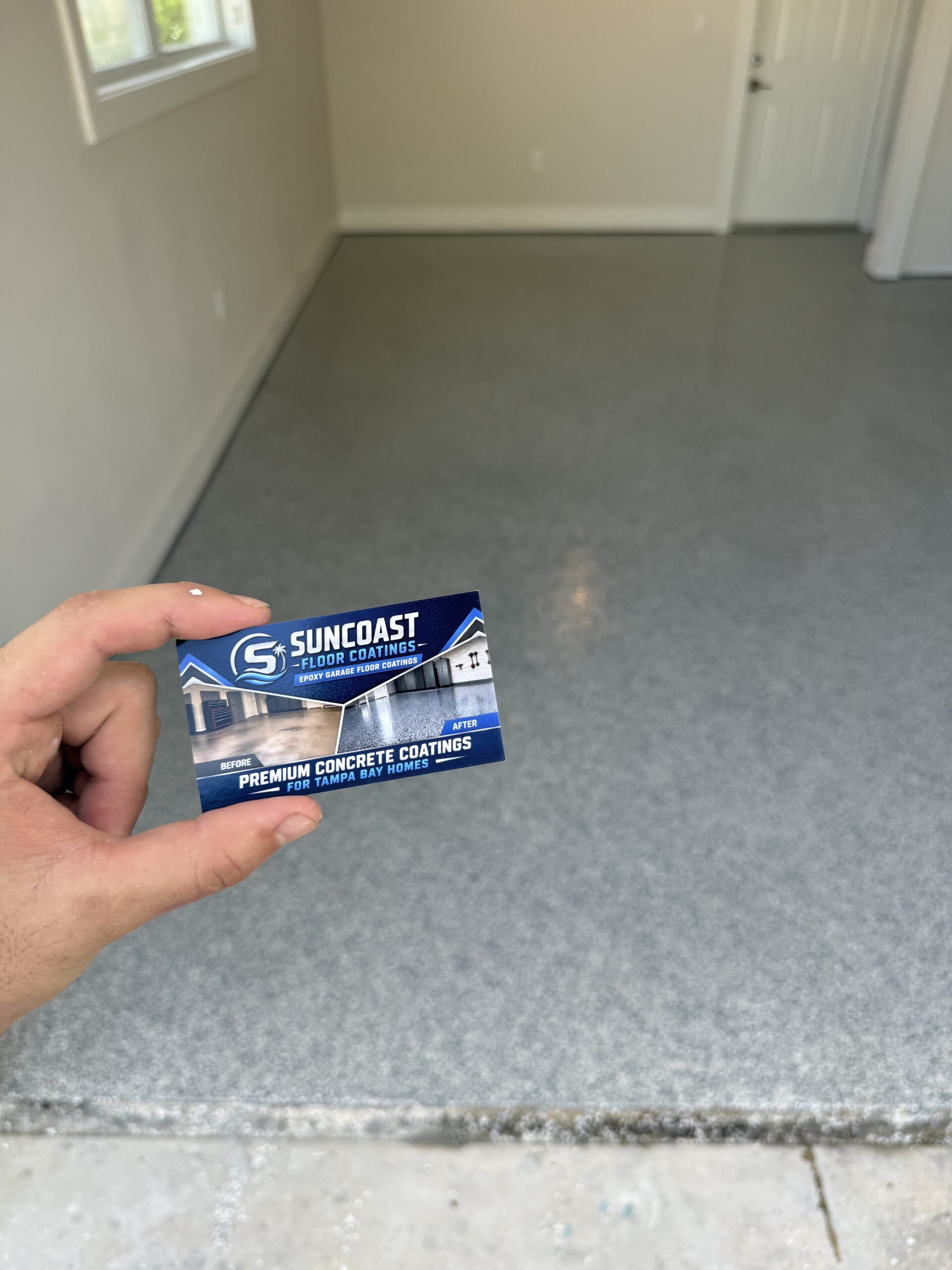
Garage Floor Coatings in Pinellas County, FL
Full-flake garage floor systems installed with professional diamond grinding, an epoxy base coat, and a UV-stable polyaspartic clear coat — built for Florida heat, humidity, and hot tires.Quick answer: What garage floor coating works best in Florida?
For most Pinellas County garages, we recommend a full-flake floor with diamond-ground preparation, an epoxy base coat, and a UV-stable polyaspartic clear coat. Epoxy bonds well to properly prepared concrete, while the polyaspartic topcoat helps resist UV yellowing, abrasion, chemicals, and hot-tire pickup.- Typical installation: one day for qualifying residential garages
- Typical return to service: walk-on in 12–24 hours and vehicle traffic in 48–72 hours
- Typical local price: $1,800–$4,500+, with many 2-car garages at $2,500–$3,800
- Local coverage: Seminole, Clearwater, and communities throughout Pinellas County and Tampa Bay
See the garage floor coating cost guide or request a written estimate for your specific slab.
Our Full-Flake Garage Floor System
Most garage floors we install follow the same proven process. Here is exactly what happens on installation day.- Diamond grinding. We mechanically grind the entire slab with diamond tooling to open the concrete pores and remove laitance, old sealers, and paint. This is what makes the coating bond — we never rely on acid etching.
- Crack and surface repair. Hairline cracks, pits, and minor spalling are filled and ground flush so they don’t telegraph through the finished floor.
- Epoxy base coat. A high-solids epoxy base coat is rolled on. Epoxy penetrates and grips ground concrete better than most alternatives, which is why we use it as the foundation of the system.
- Full flake broadcast. Vinyl flake is broadcast to full rejection — meaning the floor physically can’t hold any more flake. That’s what gives the finish its depth, texture, and ability to hide dust and dirt.
- Scrape and clean. Once the base coat cures, we scrape off loose flake and vacuum the floor so the surface is even and consistent.
- Polyaspartic clear coat. A UV-stable polyaspartic topcoat locks everything in. It won’t yellow near an open garage door and resists hot tire pickup, chemicals, and abrasion.
Most single-family garage floors are completed in one day. You can usually walk on the floor within 12–24 hours and park on it within 48–72 hours. If your slab needs moisture mitigation or major repair, we’ll tell you up front — some floors legitimately need more than a day, and we won’t pretend otherwise.
Epoxy or Polyaspartic? Honestly — Both.
Plenty of companies market one chemistry as “better in every way.” The truth is more useful.Epoxy is a proven, high-build resin that bonds extremely well to properly ground concrete. Its weakness is UV: exposed to direct sun, it ambers over time. Polyaspartic cures fast, is UV-stable, and is very abrasion-resistant — but as a base coat it can be less forgiving on marginal concrete and cures so quickly that flake coverage can suffer in unskilled hands.
That’s why our standard residential system uses an epoxy base coat for adhesion and a polyaspartic clear coat for UV stability and fast return to service. Where a full polyaspartic system genuinely fits a project better — like a job that needs same-day drive-on time — we’ll recommend that instead and explain why. You’ll always know which products are going on your floor.
Why Preparation Decides Whether Your Floor Lasts
Nearly every peeling garage floor in Florida failed at the bond line — not in the coating itself.DIY kits and low-bid installers skip mechanical grinding because it’s the hardest, dustiest part of the job. Acid etching leaves concrete smooth and often contaminated, and coatings applied over it routinely fail within a few years — especially with Florida’s slab moisture and heat. We grind every square foot with dust-controlled diamond grinders, check for moisture problems before coating, and repair the surface so the system bonds to sound, open concrete. It’s slower. It’s also why the floor stays down.
What Does It Cost?
Straight answer: most residential garage floor coatings in our area run from about $1,800 to $4,500+ depending on size, condition, and system. A typical 2-car garage with a full-flake system usually lands between $2,500 and $3,800.Garage Floor Coating Questions
What Pinellas County homeowners ask us most.Do you use real full flake, or a light “salt and pepper” broadcast?
Full broadcast to rejection. We apply flake until the base coat physically cannot hold more, then scrape and clear coat. A partial broadcast uses less material and shows roller marks and wear paths much sooner.Can you coat over an old or peeling coating?
Not directly. Failed coatings have to be ground off so the new system bonds to bare concrete. We do this removal in-house as part of prep — it’s a common situation in Florida garages and we’ll price it in your estimate.Will the floor be slippery?
A full-flake floor has natural texture and generally offers more grip than sealed bare concrete. If you want extra traction — for example near a door that catches rain — we can add anti-slip aggregate to the topcoat.How soon can I park on it?
Typically 48–72 hours after installation, and you can usually walk on it within 12–24 hours. We’ll give you exact times for the system we install, since polyaspartic topcoats cure faster than traditional epoxy clears.Serving Pinellas County & Tampa Bay
We’re based in Seminole and install garage floor coatings throughout Pinellas County — including Seminole, Largo, Clearwater, St. Petersburg, and Pinellas Park — plus the greater Tampa Bay area. See all service areas →
Get an Honest Number for Your Floor
Most estimates delivered same day. No pressure, no obligation — a written price for a floor that lasts.